
Effluent Treatment Plant (ETP)
ETP is a type of wastewater treatment method that is particularly designed to purify industrial wastewater for reuse. It aims to release safe water to the environment to prevent the harmful effects caused by the effluent.
Industrial effluent contains various materials, depending on the industry. Some effluent contains oils and grease, and some contain toxic materials (e.g., cyanide). Effluent from food and beverage factories contains degradable organic pollutants. Since industrial wastewater contains impurities, a specific treatment technology called ETP is required.
The ETP Plant works at various levels and involves various physical, chemical, biological, and membrane processes to treat wastewater from different industrial sectors, such as chemicals, drugs, pharmaceuticals, refineries, dairy, ready-mix plants, and textiles.
Benefits of ETP
- To clean industry effluent and recycle it for further use
- To reduce the usage of fresh water in industries
- To preserve the natural environment against pollution
- To meet the standards for emission of pollutants set by the government and avoid heavy penalty
- To reduce expenditure on water acquisition.
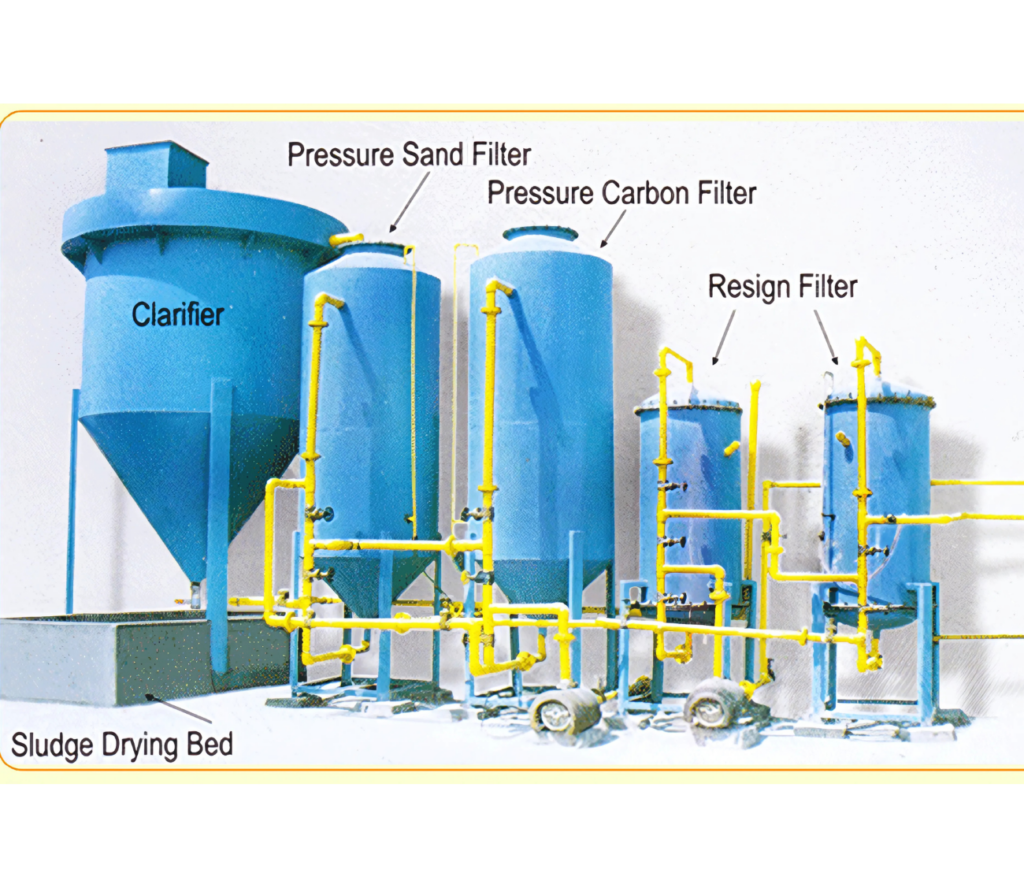
Industrial Effluent Treatment Process
The treatment of different effluents varies with the type of effluent. Wastewater enters the effluent or sewage treatment plant and goes through several processes before the effluent goes into the environment. The industrial effluent treatment plant process includes the following stages:
This is the first unit operation that occurs in wastewater treatment plants. A screen is a device with uniform openings and its purpose is to remove large floating solids.
It is a physical water treatment process using gravity to remove suspended solids from water.
These are tanks built with mechanical means for continuous removal of solids being deposited by sedimentation before biological treatment.
Its aim is the removal of floating and settleable materials such as suspended solids and organic matter. In this treatment, both physical and chemical methods are used.
Flocculation is a physical process and does not involve the neutralization of charge. It involves the addition of destabilized particles together into large aggregates so that they can be easily separated from the water.
A process in which coagulants are added for rapid settlement of minute solid particles in a liquid into larger mass. It permits particle removal by sedimentation and filtration.
The main purpose of this process is to maintain the pH range of 6-9 to meet the requirements of different processing units in the ETP system.
These are used to slow the velocity of the water to a point where organic solids will settle to the bottom of the tank and it contain equipment that is used to remove floating solids and greases from the surface.
Effluent Treatment Plant Design
The design of ETP depends on the quality and quantity of wastewater discharged from the different industries and land availability. If the availability of land in your industry is less, then the Common Effluent Treatment Plant (CETP) is preferred over the Effluent Treatment Plant (ETP).
Let’s Connect !
Contact Vrithi Eka for Solar power solutions, ETP and STP

VRITHI EKA offers sustainable rooftop solar solutions, empowering homes and businesses with clean, renewable energy for a greener future.
Quick Links
Copyright © 2024 VRITHI EKA. All Rights Reserved.
Designed and Developed By i Creative Automation